 By admin
Many people think yoga props are only for beginners, but that idea is too limited. Props can help students understand alignment, access movement safely, and build confidence. A class using a yoga wheel can be especially useful because the wheel gives support while also challenging balance, core control, and body awareness.
The yoga wheel is different from a block or strap because it moves. Its round shape supports the spine, but it also requires the student to control pressure, direction, and stability. This makes it both helpful and challenging. The prop can assist movement, but it also teaches the student how to stay engaged.
Props Are Not a Sign of Weakness
Some students avoid props because they think using support means they are not strong or flexible enough. In reality, props are learning tools. They help the body experience a pose with better alignment and less unnecessary strain.
A yoga wheel can help students explore shapes that may feel difficult without support. It may help with chest opening, spinal extension, shoulder mobility, balance, and core awareness.
Using a prop wisely often shows maturity in practice. It means the student is choosing quality over ego.
How the Yoga Wheel Supports the Spine
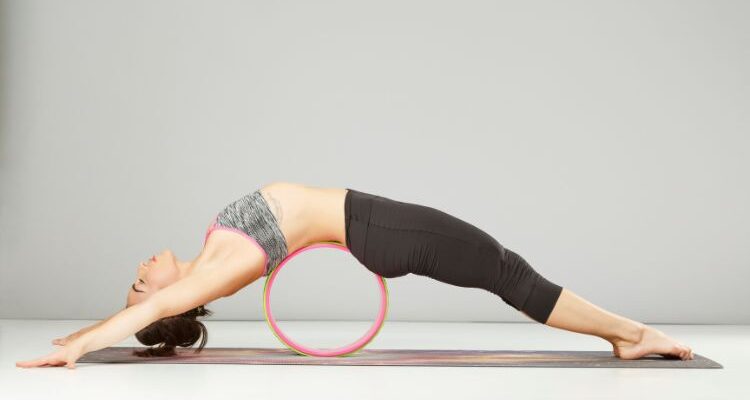
One of the most common uses of the yoga wheel is supporting the back. The curved surface can follow the natural line of the spine during supported backbends. This may help students feel more secure when opening the chest and upper body.
Instead of dropping into an unsupported backbend, the student can lean over the wheel and control the movement gradually. This can reduce fear and help the body understand the shape.
The wheel does not make every backbend safe automatically. Placement and control still matter.
Awareness Through Feedback
A good prop gives feedback. The yoga wheel shows students where they are holding tension, where they lack mobility, and where they may be moving unevenly.
For example, if the body rolls off to one side, the student may notice imbalance. If the lower back feels compressed, the student may need more core engagement or better wheel placement. If the shoulders feel tight, the arms may need a different position.
This feedback helps students become more aware instead of moving automatically.
Balance and Core Control
Because the yoga wheel can move, it challenges stability. Students may use it for supported lunges, balance drills, plank variations, or controlled rolling movements. These exercises require core control and attention.
The body must stabilize against the movement of the wheel. This can activate deep muscles that may not work strongly in normal stretching.
This makes the wheel useful for students who want to develop strength and control, not only flexibility.
Reducing Fear Around New Movements
Trying new yoga shapes can feel intimidating. Backbends, supported inversions, balance work, and chest openers may create fear. A prop can make the experience more approachable.
The wheel gives students something to lean into, hold, or roll against. This support can reduce uncertainty. When students feel safer, they are more willing to explore.
Fear reduces when the practice is broken into manageable steps.
Helping Desk-Bound Students
Desk-bound students often have tight chests, stiff upper backs, weak core support, and poor posture awareness. The yoga wheel can help address these areas through supported extension, shoulder opening, and controlled strengthening.
A simple wheel-supported chest opener may feel very different from normal stretching because it allows the body to rest into the shape while still staying aware.
For desk workers, this can be a valuable way to reverse some of the forward-rounding patterns created by work habits.
Why Teacher Guidance Matters
The yoga wheel looks simple, but technique matters. A teacher can help students place the wheel correctly, enter poses safely, and avoid overloading sensitive areas.
Without guidance, students may push too far, especially in backbends. They may also use the wheel in ways that strain the wrists, shoulders, or lower back.
A guided class helps students understand both the benefits and limits of the prop.
How to Approach the First Class
First-time students should begin with curiosity, not ambition. The goal is not to perform dramatic poses immediately. The goal is to learn how the wheel feels, how the body responds, and where support is needed.
Students should move slowly, breathe steadily, and avoid comparing themselves with others. Even basic wheel work can feel intense if the body is stiff or unfamiliar with the prop.
Progress should be built gradually.
When to Modify or Stop
Students should modify if they feel sharp pain, joint pressure, dizziness, numbness, or breath restriction. A strong stretch is acceptable only when it remains manageable.
The wheel can be adjusted in height, placement, or angle. Students can also use blankets or choose simpler versions of poses.
A useful prop-based practice should feel challenging but safe.
Making Props Part of Long-Term Wellness
The yoga wheel can become part of a broader wellness routine. It may complement mat yoga, Pilates, strength training, mobility work, or recovery sessions. It can help students understand the body in new ways.
For people in Singapore who want a guided prop-based practice that supports mobility, confidence, and control, Yoga Edition can be part of a structured yoga routine where the wheel helps students move with better awareness.
FAQs
Is the yoga wheel only for flexible people?
No. It can be useful for stiff students too, especially when used gently. Flexible students may use it for control, while stiff students may use it for support and gradual opening.
What size yoga wheel should I use?
Wheel size depends on body size, comfort, and intended use. In a studio class, ask the teacher which wheel is suitable. A wheel that feels too high or unstable may not be ideal for beginners.
Can I practice with a yoga wheel at home after one class?
You can practice simple movements, but avoid advanced backbends or balance work alone until you understand safe setup. Start with basic supported positions.